
Real-time telecom intelligence — across Marketing, Care, Network, Operations, and Finance
Unify subscriber, network, usage, revenue, and operational data into a correlated real-time analytics foundation, then let domain AI assistants deliver sub-second answers in plain language.
The telecom reality
Telecom data is extreme: operators can generate billions of daily events across probes, DPI, OSS counters, CRM, billing, and more. Generic cloud/streaming stacks often struggle with cost, latency, rigid models, and insights trapped in silos, leaving business and operations disconnected.
What we deliver for telcos
A unified Data + AI Fabric for telecom
-
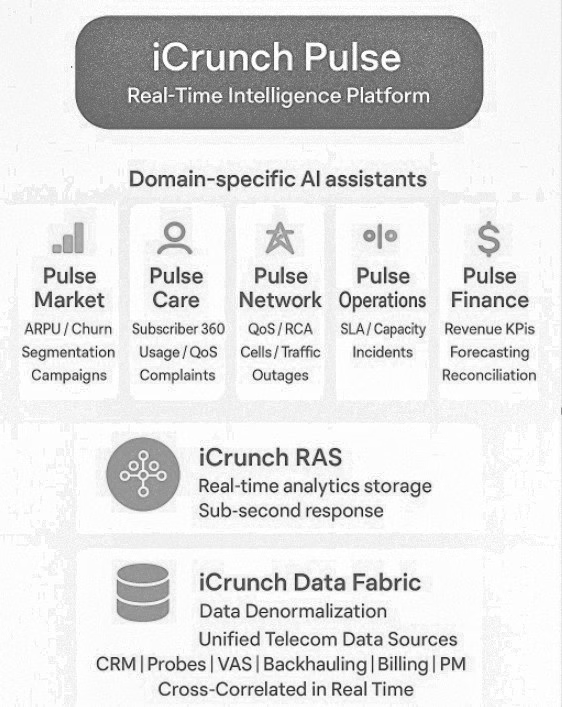
- Real-time Data Fabric to ingest and correlate multi-domain telecom data (network + subscriber + usage + revenue + operations).
- iCrunch RAS (Real-Time Analytics Storage) for sub-second analytics at extreme scale.
- iCrunch Pulse: domain-specialized AI assistants that understand telecom KPIs, terms, and workflows.
iCrunch Pulse: AI assistants built for telecom teams
Pulse Market, Pulse Care, Pulse Network, Pulse Operations, Pulse Finance — each assistant is specialized to your telco context and operates on top of a correlated, denormalized RAS schema for fast, consistent results
How it works
-
-
- Ask a question in natural language
- A private, fine-tuned model understands telecom intent and KPIs
- Optimized SQL is generated for the correlated RAS schema
- Execution stays inside your infrastructure (no data leaves)
- Results return instantly as KPIs, tables, charts, and explanations
-
Why it’s different from “NLQ on a data warehouse”
Generic NLQ/BI tools mostly generate SQL but still rely on slow, fragmented, normalized backends with heavy joins and inconsistent KPI definitions across teams. Pulse combines the interface and the performance foundation (Fabric + RAS).
The KEY challenge: Cross-domain RCA needs the right foundation (CMTV)
Automated RCA (Root Cause Analysis) isn’t “magic AI.” It starts with deterministic cross-domain correlation.
The CMTV (Cross Domain Meta Troubleshooting Vector) provides a unified vectorization and reconciliation foundation to correlate Radio, Access/Core, Transport, and Subscriber context — enabling fast, explainable root cause analysis at scale.
Two-step approach
-
-
- Step 1 (mandatory): Build the CMTV foundation — unified data, deterministic correlation, stable RCA baseline independent of AI.
- Step 2 (optional): Add AI on top — earlier detection, noise reduction, incident grouping, configuration risk scoring, higher diagnostic confidence.
- Step 1 (mandatory): Build the CMTV foundation — unified data, deterministic correlation, stable RCA baseline independent of AI.
-
Measured gains (proof points)
-
-
- 50–80% MTTR reduction
- Detect anomalies 30–90 minutes earlier
- 50–90% alarm noise reduction
- 20–50% fewer escalations
-